
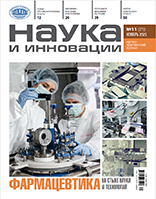
Ноябрь

Новости НАН Беларуси
- Утверждена структура государственных программ научных исследований на 2026–2030 годы
- Образ будущего Беларуси 2026–2030
- Конкурс научно-исследовательских работ для включения их в качестве заданий в государственные программы научных исследований на 2026–2030 годы
- Сергей Щербаков назначен заместителем Председателя Президиума НАН Беларуси
- Поздравление c Днем НАН Беларуси от Председателя Президиума НАН Беларуси Владимира Степановича Караника
Наши партнеры


Number 4 (230) 2021
Natalia Minakova
Forest ecosystems for life, economy, and soul
The First Deputy Minister of Forestry Alexander Dragun talks about the goals and results of the State Program "Belarusian Forest" for 2021–2025 implementation.
Alexander Kovalevich, Vladimir Padutov, Oleg Baranov, Alexander Sidor, Dmitry Kagan, Svetlana Ivanovskaya
Conservation and rational use of forests on a selection and genetic basis
The article considers the features of the forest seed base organization in Belarus. The gene pool of forest-forming species in forest stands of various protection categories has been analyzed, and the main aspects of conservation of forest genetic resources shown.
Uladzimir Usenia
The problem of pine stands dieback in Belarus and ways to solve it
The article considers the dynamics of pine stands dieback on the territory of Belarus and methods of the monitoring, prevention and control of this pathological process. The author shows the promising ways of minimizing the pine stands decline and reforestation of these areas under climate change.
Valery Liushtyk, Viachaslau Sipach, Aliaksei Novikau, Aleh Siamionau, Natallia Tupitsyna
State Nature Conservation Institution «National Park «Narochansky»
The authors consider the opportunity to use the modern geoinformation systems and technologies in specially protected natural areas of Belarus by the example of the state nature conservation institution "National Park" Narochansky".
Viktar Kalesnikovich
Analysis of the natural resource complex «Ruzhanskaya pushcha»
A better way to solve the research, recreational, ecological and other problems in specially protected natural areas has been proposed, which contributes to the disclosure of their economic and tourism potential while preserving biodiversity and historical heritage.
Tatyana Pavlyushchik, Sergey Tumel, Dmitry Taraikovsky
Restoration of the capercaillie population in the Naliboki reserve
The measures taken to restore the capercaillie population in the Belarusian forests are described.
Iryna Yemelyanovich
Government data: currency for e-government
Based on the UN study «Electronic Government 2020», the role of data in the formation of electronic government is determined as a key resource in decisionmaking and carrying out various transactions.
Victor Saverchenko, Alexander Movchan
Innovative nonpreemptive marketing platform for Belarusian business and economics
The authors present the innovative nonpreemptive marketing platform developed for Belarus’ business and analyze its influence on the national economy.
Anna Aksenevich
Key performance indicators of foreign entities of commodity distribution networks
The sound necessity of a new methodological approach has been given that would allow for a comprehensive analysis of the sales channels to foreign markets.
Petr Vityaz
Building-up of the intangible assets potential
There are given measures for the state policy in intellectual property improvement.
Yuriy Nechepurenko
Intellectual property management system in the NAS of Belarus
There is given a system of intellectual property management in the National Academy of Sciences of Belarus. It allowed the structural organizations to play a leading role in inventing, creating utility models, industrial designs, as well as licensing industrial property in the Republic of Belarus and Russian Federation. The key areas for improvement have been identified.
Tatsiana Zhdanovich
Treasure keepers. How a young Belarusian researcher revives one of the oldest folklore traditions
Yanina Hrynevich, Laureate of the V.M. Ignatovsky Prize, talks about the new life of an old song and the path to a disappearing profession.
Alexander Grusha
Institute of Belarusian culture in 1925 – 1st half of 1926: opening prospects
The author shows the key part and methods of the Inbelcult organization and new level of the task setting, as well as its full-fledged research work during the 1925 reorganization process.
Andrey Goncharov
Imaging flow cytometry for life sciences
The article provides the basic information on imaging flow cytometry, its difference from traditional cytometry and fluorescence microscopy. There are given the principles of this method, its abilities in the cells, microorganisms and microparticles analysis, the areas of application, the design of devices, the processes of accounting and data analysis.
Erna Gusakovskaya, Natalia Maksimovich
The L-NAME effects in acute experimental peritonitis
The author presents the research results on the experimental peritonitis in rats with the introduction of a non-selective NO-synthase inhibitor, N?-nitro-L-arginine methyl ester (L-NAME). It was shown that the introduction of L-NAME results in the increased severity of intoxication syndrome, aggravation of oxidative stress, damage to the endothelium of blood vessels and peritoneum.
© «Наука и инновации»
При перепечатке и цитировании ссылка на журнал обязательна. За содержание рекламных объявлений редакция ответственности не несет. Мнение редакции не всегда совпадает с мнением авторов статей. Рукописи не рецензируются и не возвращаются.


При перепечатке и цитировании ссылка на журнал обязательна. За содержание рекламных объявлений редакция ответственности не несет. Мнение редакции не всегда совпадает с мнением авторов статей. Рукописи не рецензируются и не возвращаются.