
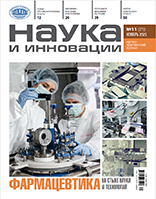
Ноябрь

Новости НАН Беларуси
- Утверждена структура государственных программ научных исследований на 2026–2030 годы
- Образ будущего Беларуси 2026–2030
- Конкурс научно-исследовательских работ для включения их в качестве заданий в государственные программы научных исследований на 2026–2030 годы
- Сергей Щербаков назначен заместителем Председателя Президиума НАН Беларуси
- Поздравление c Днем НАН Беларуси от Председателя Президиума НАН Беларуси Владимира Степановича Караника
Наши партнеры


Number 6(136) 2014
Zhanna Komarova
«Put in a word for Chemistry…»
In his interview the director of The Institute of General and Inorganic Chemistry of the National Academy of Sciences of Belarus academician Nikolay Krutko speaks about the state of the home chemical industry and its prospects, considers the new lines of the petrochemical complex development.
Tatiana Baranovskaya
Immune system and its pathology
The immune system is crucial in controlling the biological individuality of each person. The loss of these properties may cause a number of diseases. The paper considers the basics of immunological defense mechanisms of innate and adaptive immunity, cells and their metabolic products that provide health.
Irina Novikova
Modern approaches to detection of primary immunodeficiencies
The article describes the characteristics of primary immunodeficiency clinical manifestations and modern approaches to their detection. Screening tests and tests for detailed examination depending on the supposed defect in the immune system are described.
Ales Burakovsky
Immunochemical diagnostics to define the disease biomarkers
The article considers the immunochemical methods of analysis which are widely used in the clinical diagnostic laboratories to identify and quantitatively detect the disease biological markers of various genesis.
Olga Kievlyakis
he problem of hypersensitivity
There is given an information about the immune system disorder causing the allergy, external factors increasing its onset probability, and the types of this disease.
Lyudmila Maslova
Diagnostics and treatment of allergic diseases
The diagnosis of allergy is based on history, skin and provocative tests or serum- specific IgE detection. The considered treatment of allergic diseases is the following: elimination of the irritants, pharmacotherapy, allergen-specific and sublingual immunotherapy.
Vladzimir Zhernosek
Primary prevention of allergic diseases of children
The paper describes the risk factors of allergic diseases and presents the modern concepts of primary prevention of allergic diseases of children. Particular attention is paid to food tolerance induction, and the recommended time for additional food given to babies.
Irina Paramonova, Maksim Voyteshonok
Information-communicative system as a way to provide the innovation susceptibility
The article considers the need for the process of the technology transfer from research to industry improvement, updating of the R&D performed by the research institutions in accordance with the real sector of economy demands. Great attention is paid to the information-communicative system being the link between all elements of infrastructure and particularly between the generators and customers of innovations.
Irina Petrenko
Bank crediting construction and its role in the country’s economy development: the case of Belarus and Ukraine
The article considers the problems of the bank crediting construction in Belarus and Ukraine. Using the method of economic-mathematical modeling there has been shown the role of the bank crediting as an investment financing tool in the construction industry and an economical growth factor of both countries.
Denis Moroz
«Cristallization» of a scientist
It is the interview with the head of the laboratory “LCD materials and technologies” Aleksander Muravskiy about the way to science, studies abroad, research in the liquid crystals sphere.
Sviatlana Tamashevich
The home technology of the marshmallow with prebiotic properties production
The author points out the concept of functional feeding, according to which the food is a means of prevention and treatment of different diseases. There is considered the technology of the marshmallow with prebiotic properties production, developed by the specialists of the Scientific and practical food centre of the National Academy of Sciences of Belarus.
Siarhei Babich
Coworking: the concept and prospects
The article considers a new work process organization model – coworking; analyzes its main strong and weak points, geographic distribution, popularity in professional communities
Marina Basyleva
Human capital and motivational features
The subject of analysis is human capital and motivation factors in the Republic of Belarus. The purpose of the study is to determine the nature of human capital, to characterize the place of motivational components in its system, to identify the factors that motivate staff to highly productive labor.
Olga Oleks
Professional qualification education structure of national education in modern economic environment
The article defines the place and possible directions of development of professional-qualification national education structure in modern economic environment on the basis of economic activities in the European economic community classification.
Igor Kotlyarov
Belarusian education in human dimension
The article analyses the sociological researches done at the Institute of Sociology of the National Academy of Sciences of Belarus, which prove that national education system is not inferior to world standards by many features and can fulfill the tasks set by the state and society.
Irina Emelyanovich
The personnel for electronic economics
It is the interview with the pro-rector of the Belarusian State University of Informatics and Radioelectronics Elena Zhivitskaya on two new specialities set up at the University: the e-business economics and e-marketing.
Valery Yevarousky
Scientific school “History of the philosophical and social-historical thought of Belarus”. Formation period, 1960s-1970s.
The article focuses on an important component of any scientific school development, that being a methodological programme, defines its elements and main developmental trends. There is shown the extraordinary effectiveness of the national school of historical and philosophical studies formation at the initial stage.
Oleg Soroko, Semen Protasov, Anatoliy Dementiev,
Anatoliy Duk, Oleg Zheltkevich
Innovation technology of the flash-osseous flour production
In the framework of the scientific and technical programme of the Union State “Higher effectiveness of the food production as a result of their waste processing based on the progressive technologies and engineering” the scientists of the NAS of Belarus and Russian engineers developed the technology to purify the hazardous emissions in the process of the fodder production.
© «Наука и инновации»
При перепечатке и цитировании ссылка на журнал обязательна. За содержание рекламных объявлений редакция ответственности не несет. Мнение редакции не всегда совпадает с мнением авторов статей. Рукописи не рецензируются и не возвращаются.


При перепечатке и цитировании ссылка на журнал обязательна. За содержание рекламных объявлений редакция ответственности не несет. Мнение редакции не всегда совпадает с мнением авторов статей. Рукописи не рецензируются и не возвращаются.